AI watermark checking expands, but a negative result still does not prove human creation
Google’s SynthID media-checking website expands to public use, while OpenAI announces text-watermark plans for EU ChatGPT and Codex. They differ in media types, access and rollout stage, and neither makes a watermark a verdict on factual accuracy.
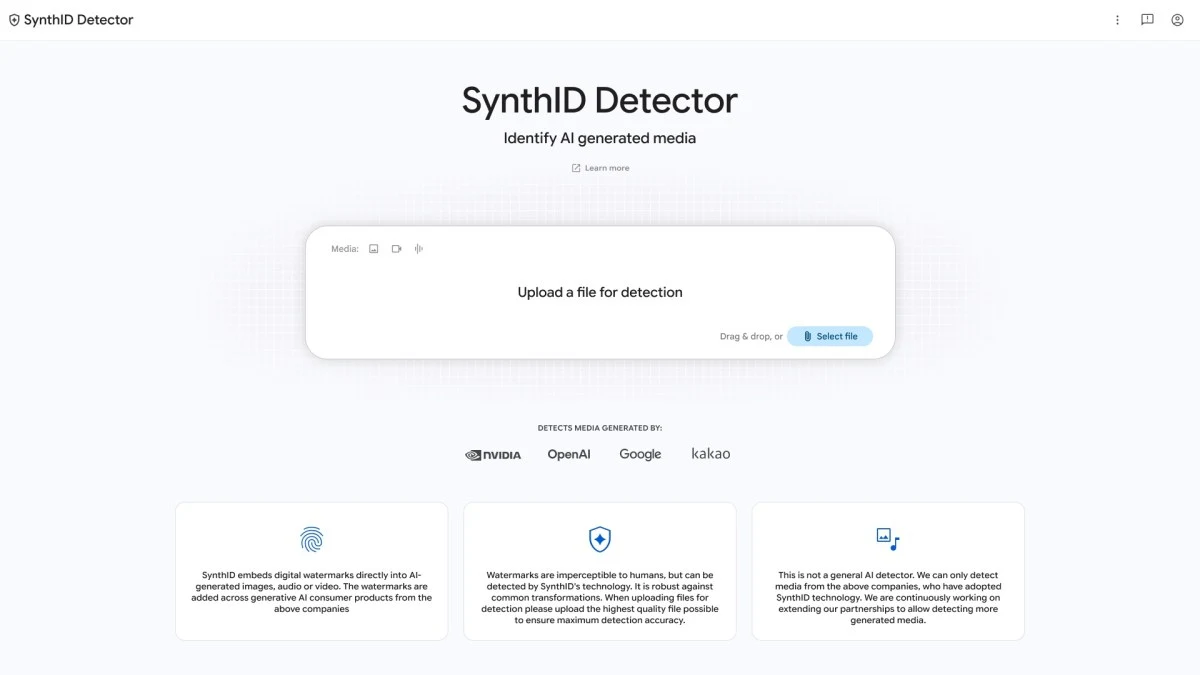
According to TechCrunch, Google opened the SynthID Detector website to the public this week so people can upload images, video or audio to check for the corresponding watermark; access previously focused on selected journalists, media professionals and researchers. It detects SynthID markings, not content from every AI system.
On October 5, OpenAI announced textGrain: global API customers can opt in for select models, with watermarking off by default. Eligible EU ChatGPT and Codex text outputs will receive invisible watermarks over the coming weeks; this is not a global default. Detector access initially goes to approved researchers and expert organizations. The approach responds to the EU AI Act’s provider marking requirement, using statistical word-choice signals to detect an OpenAI watermark.
In OpenAI’s English ELI5 evaluation, at a target 1% false-positive rate, detection was about 80% for 200-token psychology passages and 95% for 400-token passages, with lower results for mathematics. Replacing 10% of words in 400-token passages lowered detection from about 92% to 66%; replacing 25% lowered it to 17%. These figures do not establish performance across all languages or text. A watermark cannot prove accuracy, ownership or authorship; absence of detection does not prove human creation.
Together, these developments show broader access to marking and checking provenance, rather than universal detection of generated content. Media checks depend on a matching watermark, while text checks are affected by length, subject and rewriting; either result leaves the original source and the content itself to be assessed.
Sources
- Our approach to EU text provenance rules — OpenAI
- Code of Practice on Transparency of AI-generated Content — European Commission
- Google’s new SynthID website can identify AI-generated media — TechCrunch