Anthropic: evaluate folding subagents into one agent loop; Measure→Combine→Fold kit
Anthropic’s Applied AI team says that across enterprise deployments a single agent that loads skills/tools on demand often beat both one-prompt-for-everything and subagent designs on quality, often with lower cost and latency. Subagents still fit verification, parallel work, and modular permissions; do not copy the org chart blindly. The single-agent-loop-kit walks Measure→Combine→Fold with same-eval checks; the post cites a >80% Claude Code system-prompt cut via progressive disclosure. Latency/cost figures are Anthropic claims.
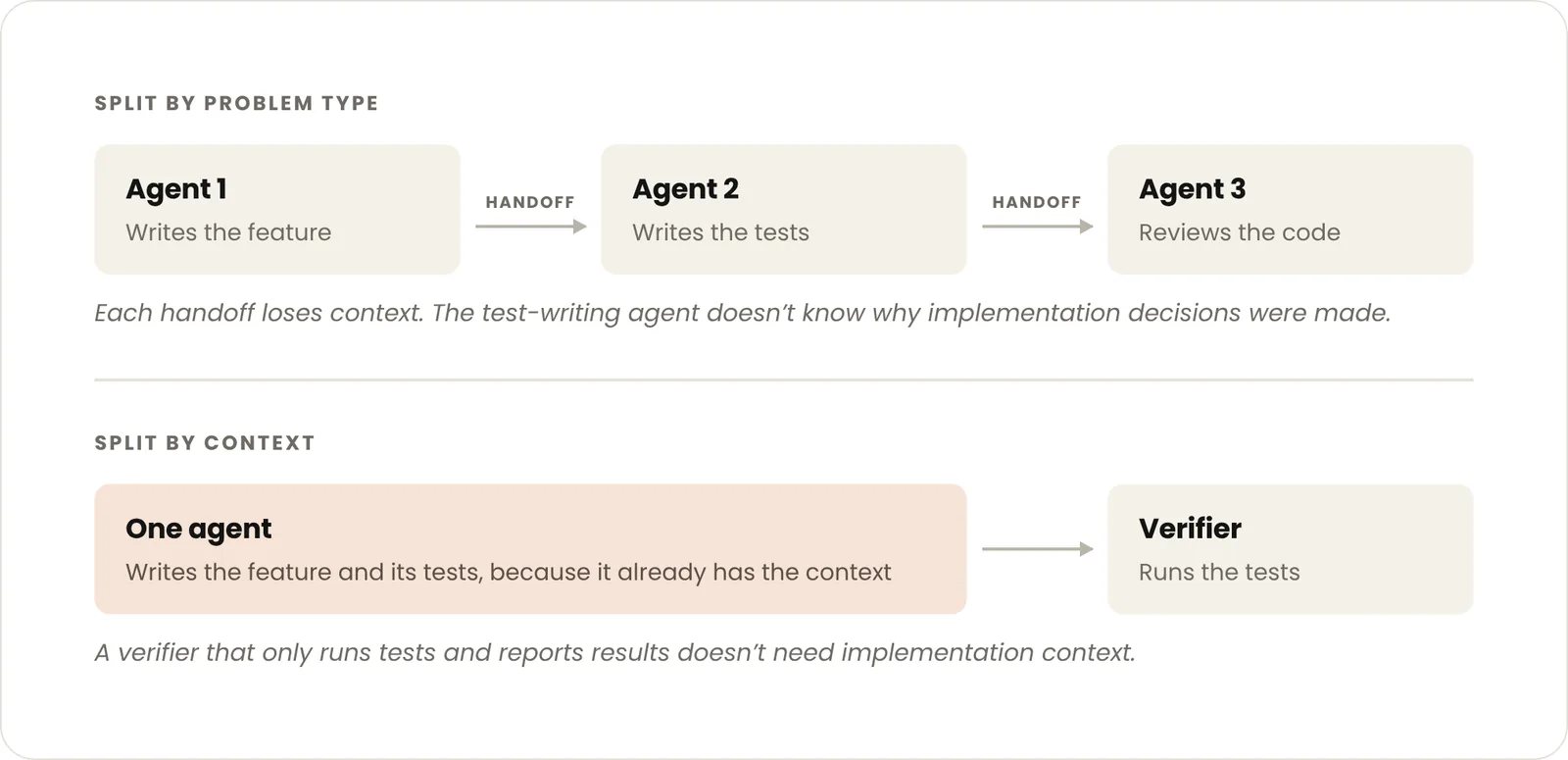
Anthropic’s Claude resources post “Building agents: When to fold subagents into your main agent loop” asks teams that already ship many subagents to evaluate folding routers, planners, and domain specialists into one main loop that progressively discloses skills and tools. Applied AI reports that across several enterprise comparisons a single agent with skills frequently outperformed both the one-prompt-for-everything design and the subagent design on quality, often at lower cost and latency per task; one customer comparison saw roughly 2× faster runtime for the single loop (vendor wording). The post criticizes Conway’s-law copies of the org chart into “a subagent per team,” lossy handoffs, Frankenprompts, and unowned local evals.
Subagents still make sense, Anthropic writes, when a single loop shows measurable degradation from context bloat; when work must run in parallel with fresh, discardable contexts; or when one agent struggles to pick tools or the system prompt holds conflicting instructions. Prefer splitting by context (independent research paths, clean-interface components, black-box verification) over splitting by problem type and playing telephone. On capability, the authors date the shift to models from Opus 4.5 onward handling far more inside one loop, and say Claude Code’s system prompt for stronger models was cut by over 80%, including progressive disclosure of skills and tools. Treat latency, cost, and prompt-length claims as Anthropic’s own.
The companion repo anthropics/single-agent-loop-kit is labeled a reference implementation—not maintained and not accepting contributions. Its path is Measure (inventory/fill evals and score today’s system) → Combine (merge subagents that always run together) → Fold (turn each remaining subagent into skills/tools in the main agent one at a time and keep only what the numbers justify). The kit “does not assume a single loop always wins”; every change is scored on the same eval before and after. It ships a support-desk example and a Claude Code skill. THE DECODER’s 2026-10-25 piece restates the guidance and the kit release.
Sources
- Building agents: When to fold subagents into your main agent loop — Anthropic / Claude
- anthropics/single-agent-loop-kit — GitHub / Anthropic
- Anthropic says one AI agent beats many subagents now that models can handle complexity alone — THE DECODER