LiquidAI launches LFM3: shared ~2B backbone from text to omni and decision models
Liquid AI introduced LFM3 on the Hugging Face Blog: text, vision, audio, omni, and decision models on one ~2B-class backbone, aimed at single-GPU fine-tuning and on-device use. It claims LFM3-1.7B beats LFM2.5-2.6B with ~35% fewer parameters, fits in ~1GB at 4-bit, and offers a 256K context; benchmark and speed figures are vendor claims.
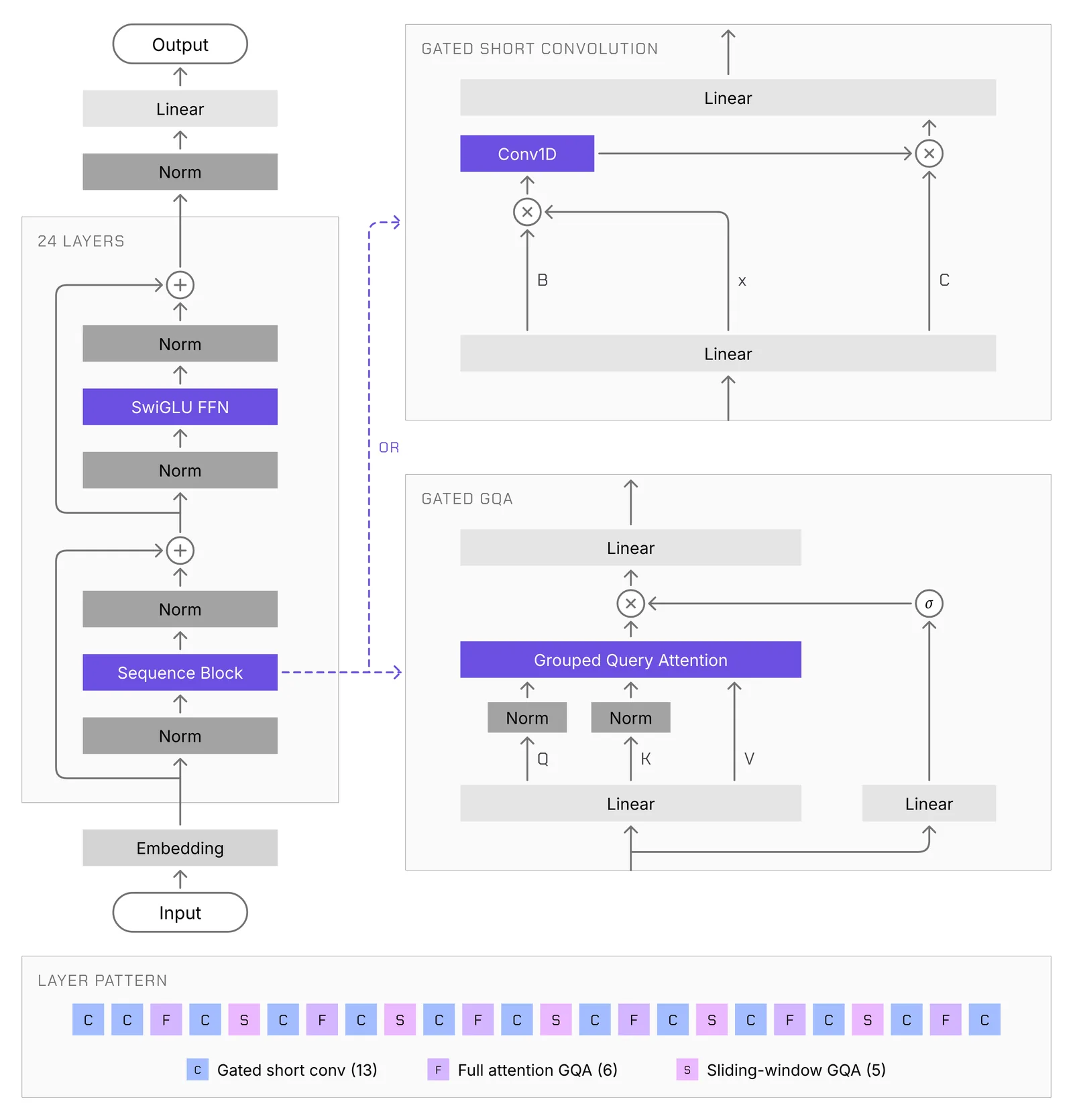
Liquid AI released LFM3, its next Liquid Foundation Models generation, as a starting point for specialized intelligence: text, vision, audio, omni, and decision models share one backbone in the ~2B range so teams can pick a modality, fine-tune on a single GPU, and deploy where the app runs. Versus LFM2, LiquidAI lists higher capability per parameter (LFM3-1.7B claimed to beat LFM2.5-2.6B with 35% fewer parameters), six 2B-class models from LFM3-1.7B-Base including a first omni model and video input for vision, edge focus (~1GB at 4-bit, in-house encoders, 256K text context), and single-GPU specialization.
LFM3-1.7B-Base is described as 24 layers with a tri-hybrid mix (13 gated short convolutions, 5 SWA layers with a 256-token window, 6 global attention), plus head-wise gated attention, Partial RoPE, and sandwich norm. Pre-training is stated at 22T tokens with a 3.5T mid-training stage richer in agentic traces that extends context to 256K. The lineup spans LFM3-1.7B, LFM3-VL-2B, LFM3-Audio-2B, LFM3-Omni-2B, and decision models d1-2B / d1-omni-2B. WebArena-Verified scores, encoder FLOPs, and TTFT claims are LiquidAI’s, not re-measured here. Snippets use transformers; model cards list other engines.
Sources
- Build specialized multimodal models with LFM3 — Liquid AI (Hugging Face Blog)