Liquid AI launches d1, a decision model that returns answer probabilities instead of text and now reads images
Liquid AI launched d1, its first “decision model”, which takes text or images plus questions and returns a probability for each possible answer in one pass without generating tokens; the company says it matched or beat GPT-6.1 Sol on four of six real-world application tests at 19 to 200 times lower cost than the models it was compared with.
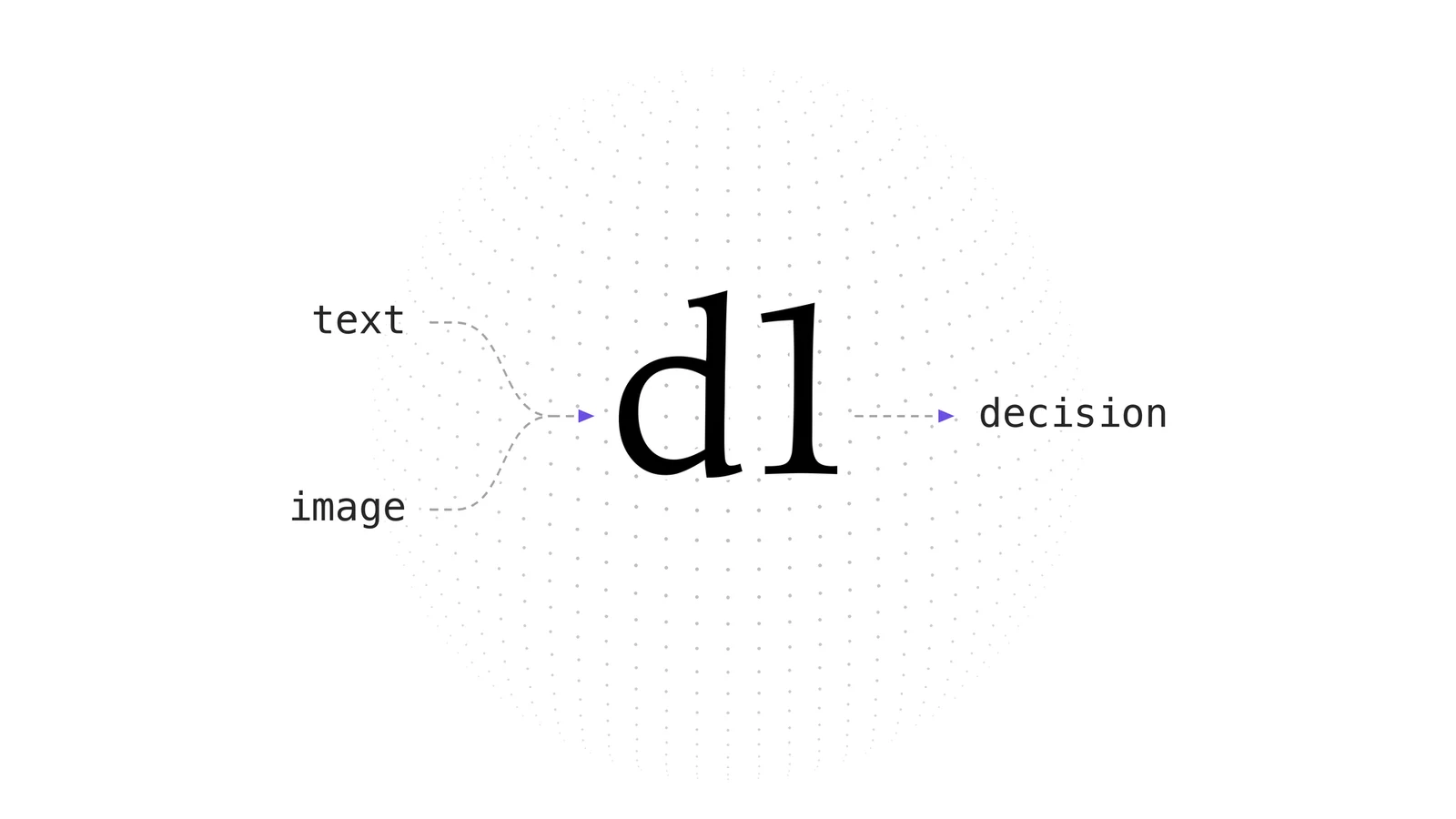
Liquid AI explains that a decision model answers questions about a situation with a probability for each possible answer. d1 takes text, images or both plus one or more questions, reads them in one forward pass and returns probabilities without generating any tokens; a text decision takes 200 to 300 ms, fast enough for real-time use. It handles three question types: yes/no questions, answered with a probability between 0 and 1; picking one label among many, with a probability per label; and scores on a scale, weighted by the probability of each level. One request can ask several questions about the same input to save input tokens.
The company says such models can replace language-model calls whose answer is a structured decision. Its demos include using d1 as a function inside a SQL query to judge, for each of 150 support tickets, whether the customer wants to cancel; sorting good and defective parts from four production lines (circuit boards, candles, cashews and chewing gum) with 85% to 97% accuracy, though the model was never trained for the task; reading tool outputs in a coding agent’s session to keep, trim or drop them, removing 52% of tokens while keeping every output the task needs; and reading Wordle boards from screenshots, solving 12 of 12 games in 3.8 guesses on average.
These comparisons were run by Liquid AI itself: on October 5, 2026, it ran each application once per model with the d1 Playground’s comparison script; GPT-6.1 Sol and Claude Opus 5.5 used their default reasoning settings, costs used list prices without prompt-cache discounts, and d1 was costed at $0.04 per million input tokens. The company also notes that six of the 15 code questions and two of the four context-compaction sessions were written after d1’s pipeline was set.
d1 is available on the Liquid AI API, with keys created at console.liquid.ai. It is billed on input tokens only, with no output tokens; images count as input at the same rate as text, at 1.5 tokens per 32×32-pixel patch, so a 1024×1024 image costs 1,536 tokens, and each question is billed as its own prompt. d1 is also on Vercel and OpenRouter, text-only for now, with vision coming later. Liquid AI says it plans to release open weights for upcoming models on Hugging Face soon.
Sources
- Introducing d1: The most capable decision model, now with vision — Liquid AI 模型与工程博客(网页)