Meta publishes six papers by mathematicians working with Muse Spark, saying five answer previously open problems
Meta published six papers from a collaboration with mathematicians, who used Muse Spark in Thinking Mode through the ordinary meta.ai chat interface to explore proofs and counterexamples before a second group of mathematicians reviewed the work; Meta says five of the papers answer previously open research questions, some of which outside teams also solved independently.
Meta says its models reached gold-medal level in five high-school Olympiads in mathematics, physics and chemistry earlier this year, which led the team to test whether AI could help scientists with open research problems. Competition problems, however hard, have known answers; open research has no answer key and no guarantee an approach will work. Over the past several months, the collaborating mathematicians used Muse Spark 1.1 and 1.2 in Thinking Mode through the ordinary meta.ai chat interface, with no custom research scaffold.
Meta lists its rules for the collaboration: one group of mathematicians led the research and worked with Muse Spark to explore ideas and develop arguments; a second group reviewed the work; each paper marks which passages were mainly written by researchers and which were drafted by AI, and credits the earlier work it builds on. Meta also acknowledges that after finishing, it learned outside teams had independently announced solutions to some of the same problems using different methods, and the papers note that work and how it relates.
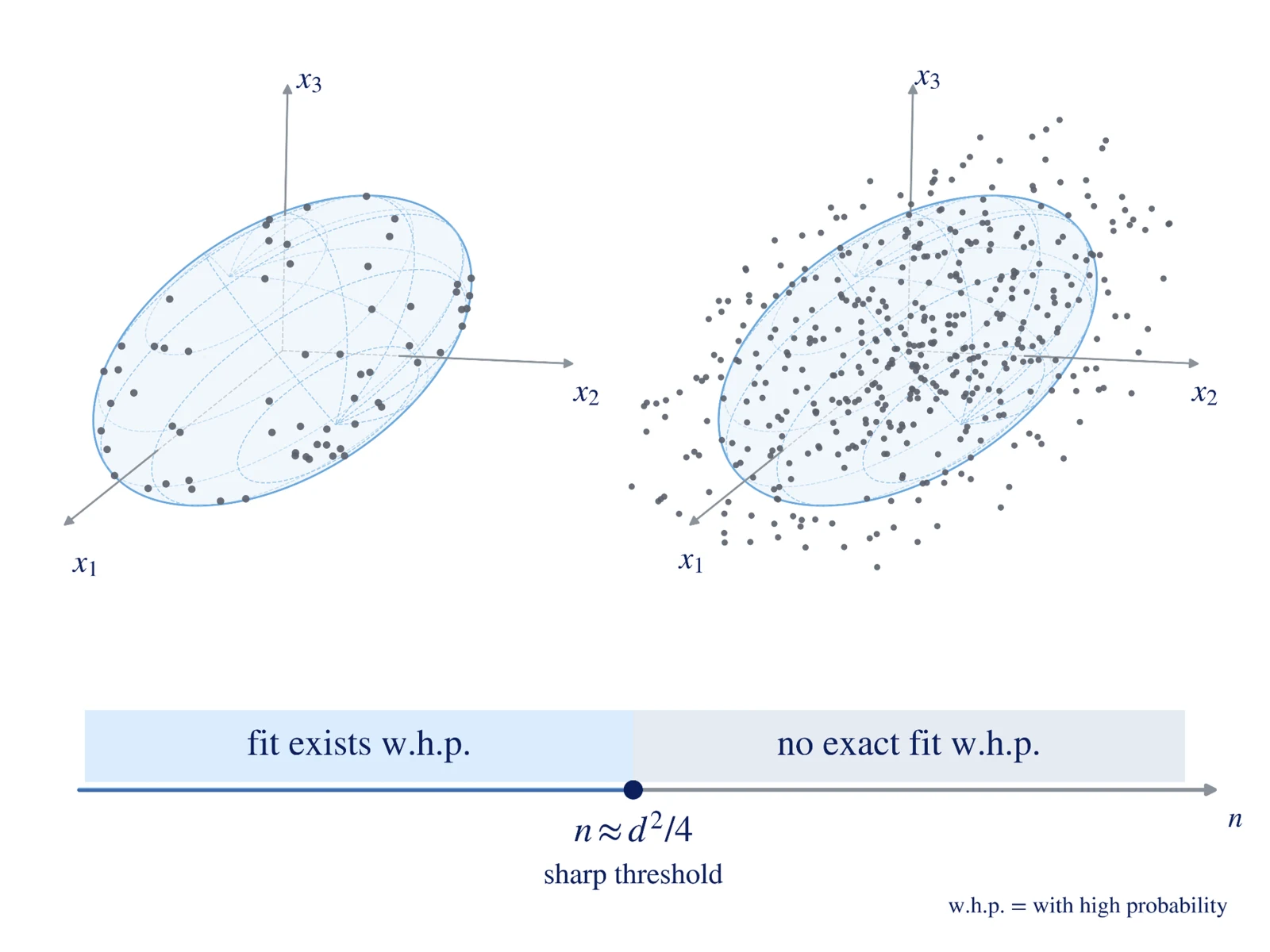
A probability paper asks whether random Gaussian points in high dimensions can all lie on an ellipsoid centered at a fixed point, and proves a sharp threshold in the number of points n at about d^2/4: below it such an ellipsoid exists with high probability, above it with high probability it does not, and the paper makes no claim exactly at the threshold. Meta notes three independent concurrent works from August 2026, including Misiakiewicz and Wen, who independently proved the same Gaussian threshold.
Among the other papers, a group theory paper found a group of order 384 that disproves a conjecture M. Kida proposed in 2024, and Muse Spark generated the GAP search program that found the counterexample; Meta notes that the AI agent Nilradical independently reported a different counterexample to the same conjecture on September 16, 2026. A differential equations paper proves that for waves in two or more dimensions that are radially symmetric with negative energy, solutions of the mass-critical biharmonic nonlinear Schrödinger equation must collapse in finite time, settling a question left open in 2015 and confirming a 2002 prediction from computer simulations. In an arithmetic physics paper, Muse Spark also drafted three core technical sections that the researchers checked, corrected and refined.
Meta says the goal was not to mass-produce papers but to help researchers reach mathematical insights others can understand and build on. The review it describes came from the second group of mathematicians in the collaboration, and the post does not say whether the papers have passed journal peer review; some results were also reached independently by outside teams. The papers therefore show how far AI can take part in proofs and counterexample searches under mathematicians’ direction, rather than AI doing research on its own.
Sources
- Solving Open Research Problems Together — Meta AI:Research Blog(网页)
- The Strict Threshold for Gaussian Ellipsoid Fitting — ai.meta.com