Google releases open EmbeddingGemma 2: a 740M-parameter model that searches photos, video and audio on your phone
Google DeepMind released EmbeddingGemma 2, an open-weight multimodal embedding model that maps text, images, video frames and audio into one vector space; at 740M parameters and under the Apache 2.0 license, it can run semantic search and intent classification offline on phones and other devices.
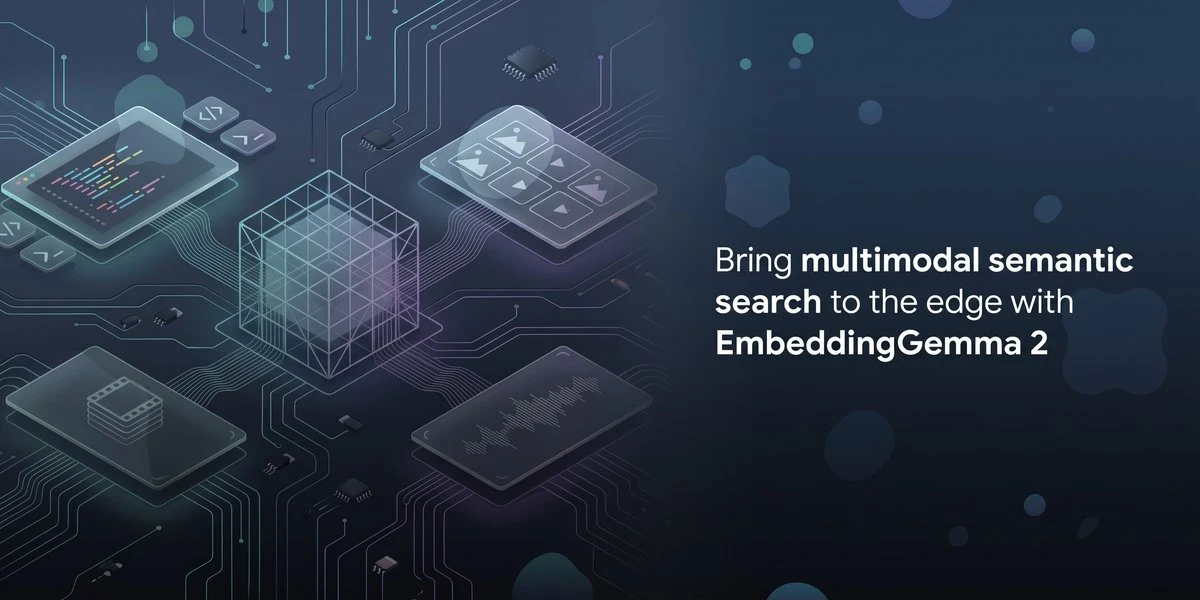
Google says EmbeddingGemma 2 is built on the Gemma 4 architecture with the same technology as its Gemini Embedding models, and puts text, code, images, video and audio into one shared embedding space, so a voice memo can find a video clip or a line of text can search hours of recordings. On-device media search used to mean chaining separate image-captioning, speech-to-text and text-embedding models; one model now does the job with lower latency and memory overhead. The first EmbeddingGemma handled text only, and Google says it has passed 20 million downloads.
The model has 740M parameters split into modules that load separately: text-only work needs just 270M parameters, with the vision encoder (170M) and audio encoder (300M) added as needed. Quantized on a Pixel 11 Pro, the text-only weights use about 191MB of active RAM and the full multimodal model about 567MB. The context window is 8K tokens, four times the first version, enough for up to 5.5 minutes of audio, 29 images or 58 video frames at once. Output vectors are 768-dimensional by default and can be truncated to 512, 256 or 128 dimensions to cut storage and memory for local vector databases.
Google says it leads multimodal embedding models under 1B parameters on benchmarks such as MTEB Code and MAEB (an audio embedding benchmark), matches the previous version on multilingual text, and raises its code retrieval score from 68.76 to 78.68, making it suited to local codebase indexing and retrieval for coding agents. These are Google’s own results; full evaluations are in its model card.
Everyday users can try two new demos in the Google AI Edge Gallery app on Android and iOS: one finds photos in the phone’s local library from a text query or example image, updating as you type, with no internet connection required; the other jumps to moments such as “dog catching a frisbee” inside a local video without first transcribing audio or writing captions. Google also launched Google AI Edge Foresight, an experimental Mac app that uses Gemma 4 locally to enrich meeting notes and search your files, and works with any meeting platform.
Developers can download the weights from Hugging Face and Kaggle; the model works with common tools including transformers, sentence-transformers, MLX, vLLM, llama.cpp and Ollama, and is released under the commercially permissive Apache 2.0 license. Google also pitches it as an on-device “decision engine” that matches inputs directly against classification labels for zero-shot intent routing with no training data or fine-tuning; in a demo, the MediaPipe Decision task evaluates 500 chess moves per turn in under 100ms. On a MacBook M5 Pro GPU, a single image’s vision embedding takes as little as 37.3 ms. ML Kit support on Android is coming in the next few weeks, with NPU acceleration on supported devices.
Sources
- Bring multimodal semantic search to the edge with EmbeddingGemma 2 — Google Developers Blog(RSS)
- EmbeddingGemma 2: an open, lightweight multimodal embedding model — Google