Claude Haiku 5.5 cuts short-prompt prices, with a fivefold higher long-context tier
Anthropic has released Claude Haiku 5.5, adding adjustable effort and adaptive thinking to the Haiku family for high-volume tasks such as summarization and classification. Independent testing shows a substantial capability gain, but output is heavy at maximum effort, so task costs still depend on prompt length and reasoning settings.
API unit prices fall sharply for shorter prompts, with a clear threshold. For prompts up to 100k tokens, input and output cost $0.10 and $0.50 per million tokens; above 100k, they rise fivefold to $0.50 and $2.50. Cache reads cost $0.01 or $0.05 per million tokens, and five-minute cache writes cost $0.125 or $0.625, using the same prompt-length threshold.
Haiku 5.5 accepts text and images and returns text, with a context window expanded from its predecessor’s 200k to 1 million tokens. Anthropic positions it for narrowly scoped, high-volume work such as summarization, context compaction, database queries, classification and coding subagents; it still recommends Sonnet 5.5 or Opus 5.5 for complex, multi-step coding. The company says the model is available on the Claude Platform, Amazon Web Services, Google Cloud and Microsoft Azure, with the Claude Platform model ID claude-haiku-5-5.
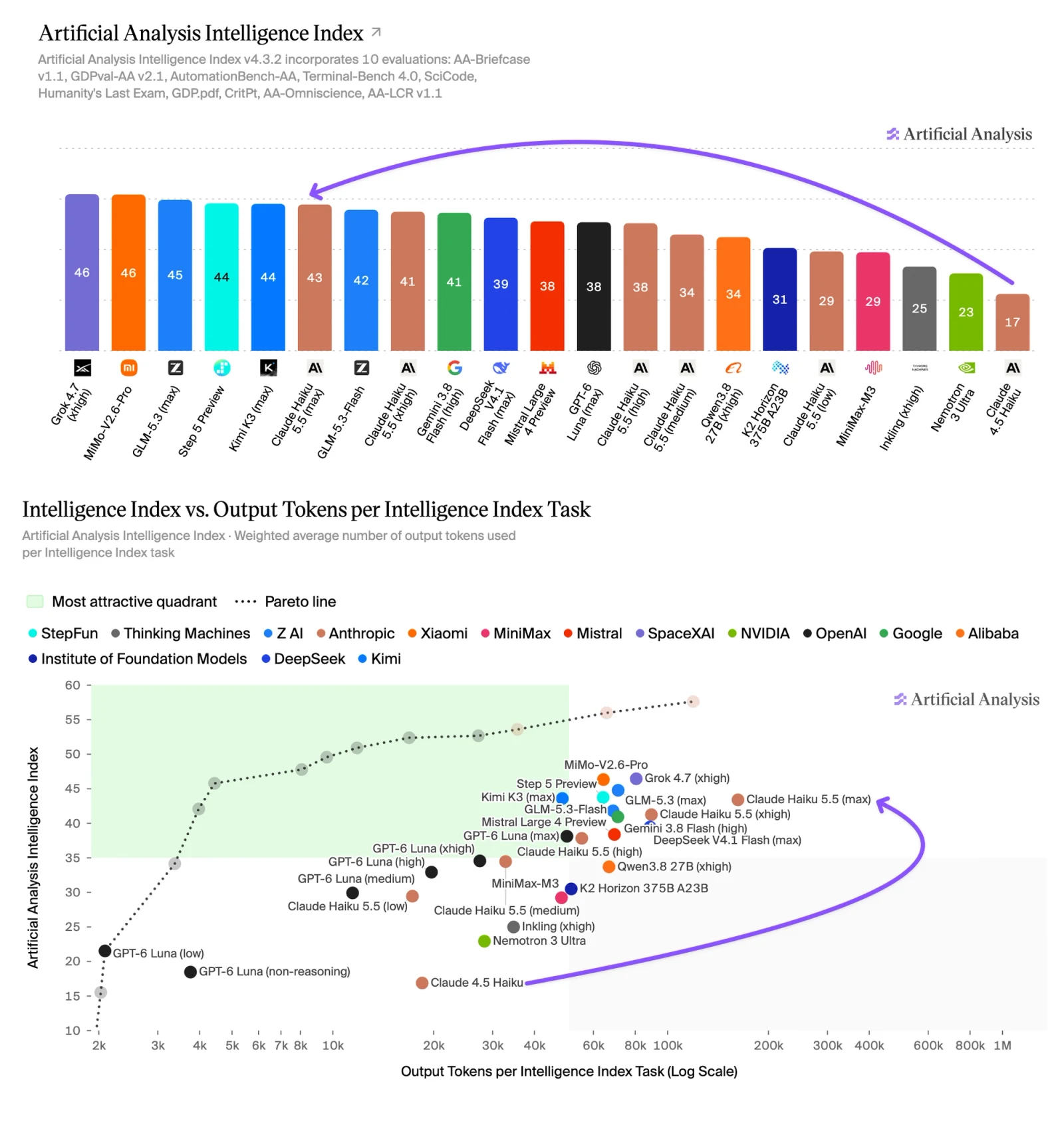
In its independent evaluation published October 7, Artificial Analysis gave Haiku 5.5 at maximum effort an Intelligence Index score of 43, up 26 points from its predecessor but below Sonnet 5.5 at max effort, which scored 56. Haiku 5.5 scored 33% on Terminal-Bench 4.0 command-line tasks, versus 0% for its predecessor. These tests show improved capability, rather than a wholesale replacement for larger models.
Maximum effort requires substantially more output: Haiku 5.5 at max uses roughly 162k output tokens per Intelligence Index task, about three times GPT-6 Luna at max, at roughly 50k. Moving from xhigh to max adds only 2 points while using about 1.8 times as many output tokens. Artificial Analysis also says its provisional cost figures do not yet include the price jump for prompts above 100k. A lower token price therefore does not establish the same proportional saving on every task.
Performance is uneven. Haiku 5.5 scored 36% accuracy on Artificial Analysis’s AA-Omniscience factual-knowledge test. The evaluator says it was more willing to admit uncertainty and had a lower hallucination rate than the Gemini 3.8 Flash and GPT-6 Luna results compared in the report. It scored 35% on AutomationBench-AA; the evaluator attributed part of that result to excessive refusals in pre-release testing and said Anthropic was working on the issue before a rerun. That score is not a post-fix result.
The same official announcement also gives a Sonnet 5.5 cache-read price cut from $0.20 to $0.10 per million tokens. Anthropic estimates that this lowers the cost of most agentic tasks by around 20%; the actual saving depends on cache usage.
The announcement also previews monthly Claude Platform API credits usable with any model: $100 for Max 5x, $200 for Max 20x, and up to $500 pooled across Team subscribers. It describes the rollout only as “this week” and carries no confirmed calendar date, so these remain announced credits rather than evidence that every eligible account has already received them.
Sources
- Anthropic has released Claude Haiku 5.5 — Artificial Analysis 完整文章(网页)
- Introducing Claude Haiku 5.5 — Anthropic:Newsroom(网页)