Anthropic explains agent memory: Claude can “dream” between sessions, but wikis do not always beat search
In a November 6 engineering research post, Anthropic describes Claude reviewing logs between sessions to correct memory and organize linked knowledge. Its internal evaluations show gains on particular document tasks, with task-dependent benefits and extra maintenance compute. This is not an announcement of a new feature across all Claude products.
Anthropic defines agent memory here as knowledge Claude gains from interactions and assigned tasks, retains across sessions, and later reads as context. It excludes changes to model weights, in-context learning within a conversation, and compaction. Dreaming means reviewing logs or transcripts between interactions to check notes, correct mistakes and build new memory representations. The post also credits earlier sleep-time compute work from Letta and UC Berkeley.
The design is not simply about storing more. In a Pokémon experiment, Claude misremembered a landmark location and repeatedly took the wrong route. Checking its notes against the original transcript corrected the mistake and changed its subsequent path. Anthropic also found that stronger models were better at judging what to remember: a fixed instruction to record only failures reduced some models’ gains from memory.
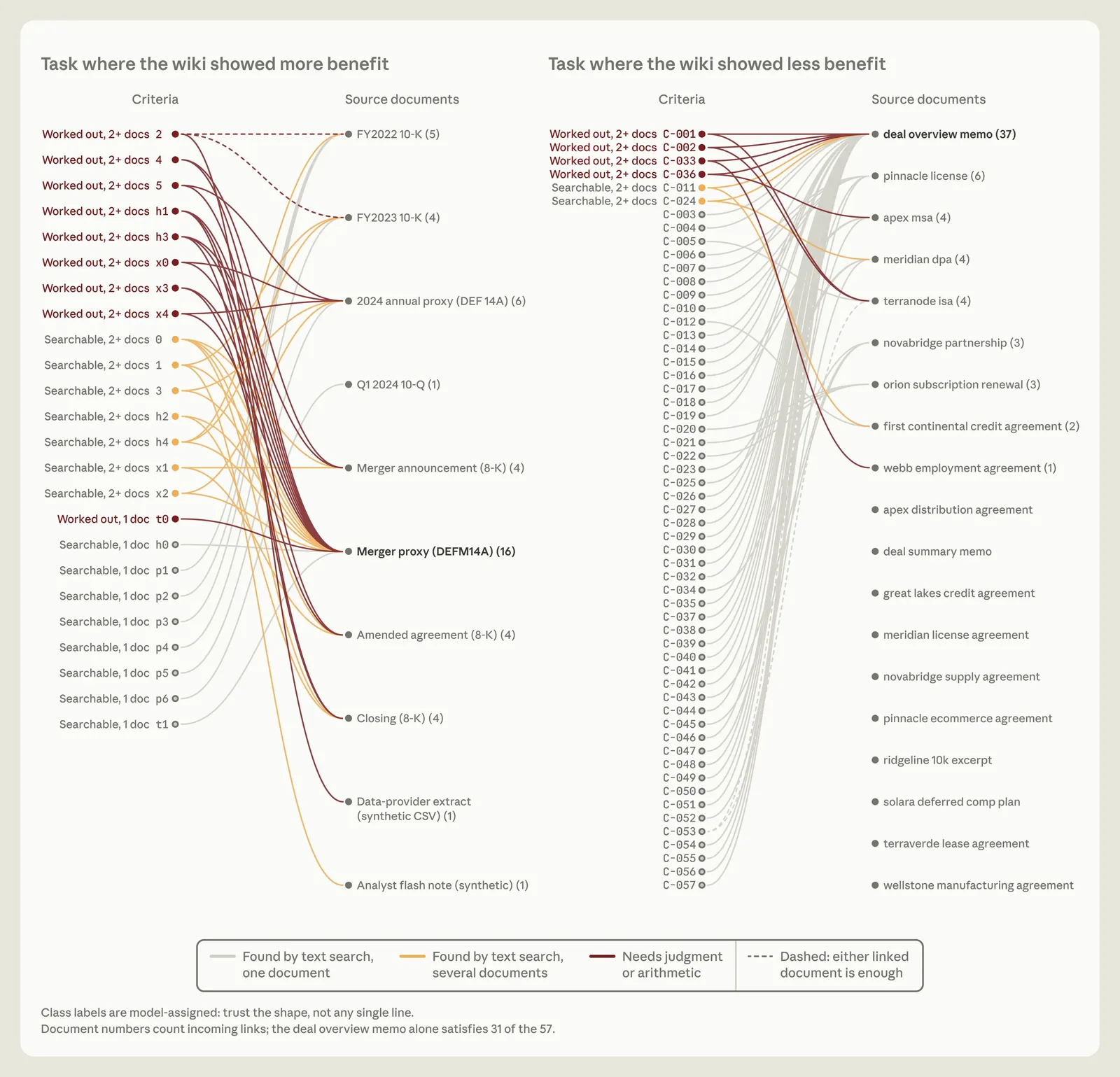
In an experiment using internal Stainless documents, Anthropic built a corpus of about 350,000 files, roughly 420 million tokens, and had Opus 5 agents gradually construct a linked wiki over 128 dreaming sessions. On 25 questions, the share of graded criteria met using only the wiki grew from 13% to 48% as the wiki developed. This is an internal result on a particular document-question task, not general accuracy or an improvement across ordinary chat.
The effects of search and the wiki need to be separated. In the same experiment, the aggregate score with both search and the wiki rose from 54% to 61% as the wiki grew, versus 53% with search alone. In another test with 24 merger questions, the subset of criteria requiring cross-document synthesis, judgment or arithmetic scored 87% with the wiki versus 73% with search alone. But on legal tasks answerable by searching a single document, the wiki showed no clear benefit, and sometimes grew larger than the source material.
Memory organization can itself introduce errors. In one contract experiment, agents editing a shared table overwrote important information. Giving each contract a separate page, written by one agent and quoting clauses verbatim, improved retention. Anthropic also warns that automatically injecting an incorrect note into every new session can repeatedly propagate the error. The top memory layer should therefore stay small, with source search used to check claims when needed.
For teams building long-running assistants, enterprise knowledge systems or multi-agent workflows, the post offers testable design lessons: retain logs as a reference, make memory correctable, and distinguish tasks that search can solve from those needing organized connections across sources. Anthropic still lists when to organize memory, how to keep it current and compute cost as open questions. The post describes research and engineering practice, not a universal dreaming toggle newly available in every Claude product.
Sources
- The components of agent memory — Anthropic