ElevenLabs launches Eleven v4 and low-latency v4 Turbo: more expressive speech in 90+ languages, available now via API and its apps
ElevenLabs has released the Eleven v4 text-to-speech model and its low-latency variant, Eleven v4 Turbo, saying the new model reads tone, pacing and emotion from context and can be directed with natural-language instructions and inline tags. Both support more than 90 languages and are available now in ElevenAgents, ElevenCreative and ElevenAPI, with a free account to try them; the announcement lists no prices.
ElevenLabs says Eleven v4 is built on an entirely new architecture that infers intended tone, pacing, character and context from the text, producing dramatic, tender, urgent, comedic or conversational delivery while keeping the speaker’s identity. Users can describe in natural language how a line should be said, or use inline tags such as [laughs] or [light rain] to set emotion, accent and sound effects; the company says v4 follows these tags more accurately than earlier models, and International Phonetic Alphabet (IPA) support is significantly improved. In multi-speaker dialogue the model understands the whole scene, so speakers respond to what was just said instead of reading stitched-together lines.
Eleven v4 Turbo targets low-latency uses such as voice agents: the company cites a median inference latency of about 100ms and a median time from request to audible speech of about 150ms (measured in September 2026 with identical scripts and default settings, network latency removed, over WebSocket streaming), and says it was optimized together with its ElevenAgents platform. Both models support more than 90 languages, and a voice recorded in one language can speak others with a native accent; Instant Voice Clones need just 10 seconds of audio, and v4 also supports higher-fidelity Professional Voice Clones (PVC).
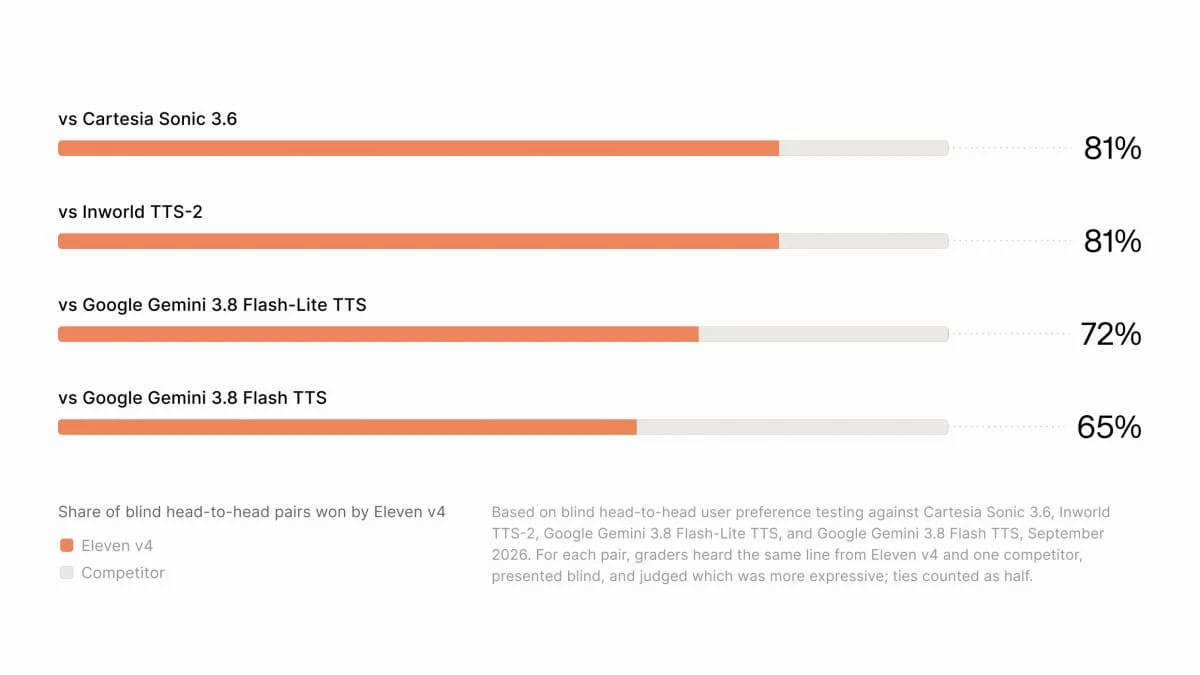
ElevenLabs says Eleven v4 ranks first on Artificial Analysis’s voice arena leaderboard (September 2026) and that in company-run blind head-to-head tests about 75% of listeners preferred it over Cartesia Sonic 3.6, Inworld TTS-2, Google Gemini 3.8 Flash-Lite TTS and Gemini 3.8 Flash TTS, with ties counted as half. The ranking, latency and preference figures are all vendor-reported; the announcement does not give v4 pricing or billing changes.
Sources
- Introducing Eleven v4, our most emotive model — ElevenLabs:Blog(网页)