Together AI launches Together Link to run Claude Code, Codex and other coding tools on open models
Together AI launched Together Link, which uses one command to connect coding agents such as Claude Code, Codex, OpenCode and Pi to open models it hosts, including Kimi K3 and GLM 5.3, while keeping existing settings and logins; the company says it cuts spending by more than half.
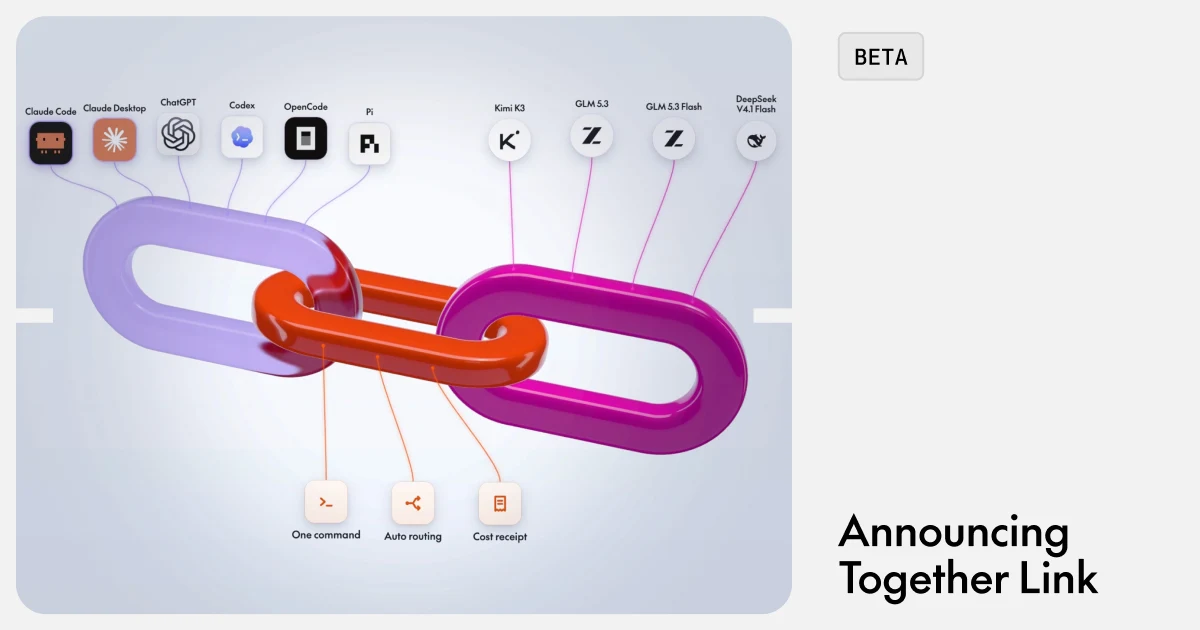
Together AI says coding agents are now standard for engineering teams, but tasks from one-line fixes to full rewrites often run on the same premium closed model, with engineering orgs spending anywhere from tens of thousands to millions of dollars a month on closed models. It argues open models have largely closed the gap: Kimi K3 and GLM 5.3 handle many of the hardest coding tasks at a fraction of the per-token price, while smaller models such as GLM 5.3 Flash and DeepSeek V4.1 Flash cover everyday coding.
Together Link currently supports Claude Code, Codex, OpenCode 2, Pi Code 0.80.8 or newer, Claude Desktop and ChatGPT Desktop; it needs macOS or Linux, and the tools must already be installed. Terminal tools get a temporary configuration for each launch that is removed when the session ends, while desktop apps use a separate Together Link profile. Your normal configuration files are not rewritten, and the blog says going back to the native closed models takes one command. Native web search is disabled in the ChatGPT Desktop Together Link profile.
The default “Auto” router chooses between fast, low-cost models and frontier models based on how hard a task is. In Claude Code and Claude Desktop, if you configure an Anthropic API key, harder requests go to Claude Opus and are billed to the Anthropic account behind that key; Codex, OpenCode, Pi Code and ChatGPT Desktop sessions, as well as Claude sessions without an Anthropic key, always stay on Together-hosted models. You can also pin a single model; in Claude Code’s model menu, the Opus tier runs Kimi K3 and the Sonnet tier runs DeepSeek V4.1 Flash.
Billing runs on your existing Together API key against serverless pay-as-you-go or credit packs, with no separate contract. Each session ends with a summary of what you spent next to what the same session would have cost on Opus 5.5. Together says that as of September 30 it served the largest share of OpenRouter tokens for DeepSeek V4.1 Flash, GLM 5.3 Flash and Kimi K3, at 40.8%, 28.2% and 23.1%. The “over 50%” savings figure is the company’s claim; the post gives no independent test or calculation details.
Sources
- Together Link: frontier-quality open models in the harness you already use — Together AI 研究与产品博客(RSS)
- Configure Claude Code, Codex, OpenCode & Pi Code with OSS models — docs.together.ai