NVIDIA: fine-tuned Nemotron 3 reaches gold-medal level at IMO 2026 and IOI 2026, with checkpoints and training data released
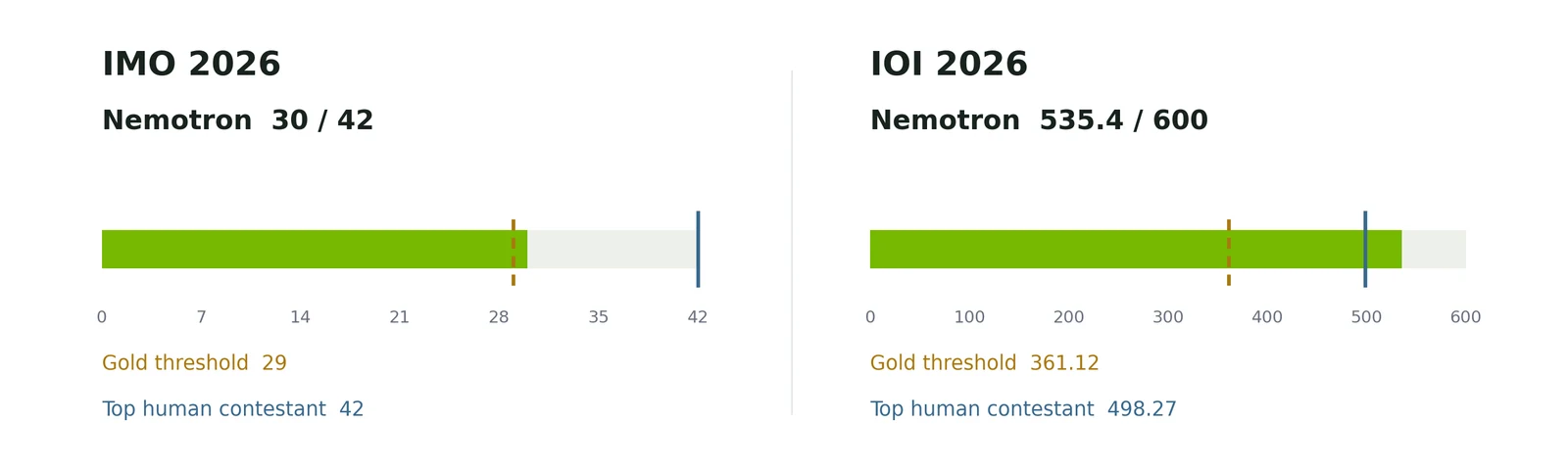
NVIDIA says on the Hugging Face blog that specialist models fine-tuned from Nemotron 3 reached gold-medal level at both the 2026 International Mathematical Olympiad (IMO) and the 2026 International Olympiad in Informatics (IOI). The IMO system scored 30/42, with its proofs graded by official IMO graders; the IOI system scored 535.4/600 in a live run under the same time, internet-access and submission limits as human contestants, but as an unofficial, unsupervised benchmark not included in the official ranking. The checkpoints, training data and inference pipelines have been released.
For competitive programming, NVIDIA curated 22,000 problems with synthetic reasoning traces and trained two specialists: Nemotron-3-Nano-CC (30 billion total, 3 billion active parameters), which received supervised fine-tuning (SFT) and reinforcement learning (RL), and Nemotron-3-Ultra-CC (550 billion total, 55 billion active parameters), which received SFT. The company says that on IOI 2025 problems Nano rose from 130 points before post-training to 280 after SFT and 291 after RL, and reached 468 with GenCorrect, its iterative generate-evaluate-refine strategy, above that year’s gold threshold of 438.3; Ultra-CC scored 502 with the same strategy. A competition-specific Ultra-CC system built on that finding was used for IOI 2026.
For mathematics, the team started from Nemotron 3 Ultra and trained one specialist with SFT and another with RL. The SFT corpus had 414,890 quality-filtered examples across 15,818 proof problems, covering proof generation, refinement, verification and meta-verification; the RL model was trained on 9,597 proof problems near the model’s capability frontier. The final system combined both specialists with the general model: for each problem it generated candidate proofs, scored them, produced critiques and refined them, and a separate high-compute stage selected the submission. It worked entirely in natural language with no formal prover, external tools or internet access, and scored 30 of 42 points, with full credit on four of six problems, above the official gold threshold.
NVIDIA says the medals came neither from fine-tuning alone nor from brute-force sampling alone, but from co-designing the model, data and inference loop; it describes the training and inference runs as “substantial” without giving compute figures. It has published a Nemotron Labs IMO 2026 collection on Hugging Face with the SFT and RL checkpoints, both training datasets and Nemotron-IMO-Bench, a new benchmark of 200 olympiad-level problems; the Nemotron-3-Ultra-CC model is also on Hugging Face, and the IMO inference pipeline, prompts and submitted proofs, plus the IOI evaluation and inference pipeline, are in the NeMo-Skills repository. Two arXiv papers describe the IMO and IOI training methods.
Sources
- One Model Family, Two Gold-Level Results: Fine-Tuning Nemotron for IOI and IMO — Hugging Face:Blog(RSS)
- An Open Recipe for IMO Gold: Training Nemotron for Olympiad Mathematics — arxiv.org
- Post-Training Language Models for Gold-Medal Performance in Coding Competitions — arxiv.org