OpenAI releases BioBasicsBench: 100 wet-lab tasks with Ligo; GPT-6 Astra scores 66.7% at highest reported effort
According to Unite.AI and AI Affairs, OpenAI on 6 November introduced BioBasicsBench with enzyme-design company Ligo—100 routine wet-lab tasks that ask agents to interpret raw experimental evidence. At xhigh, the highest reasoning-effort setting reported for all seven models tested, GPT-6 Astra averaged 66.7% of available credit versus 43.8% for GPT-5.6 Sol. OpenAI cautions that higher scores do not yet mean reliable laboratory judgment.
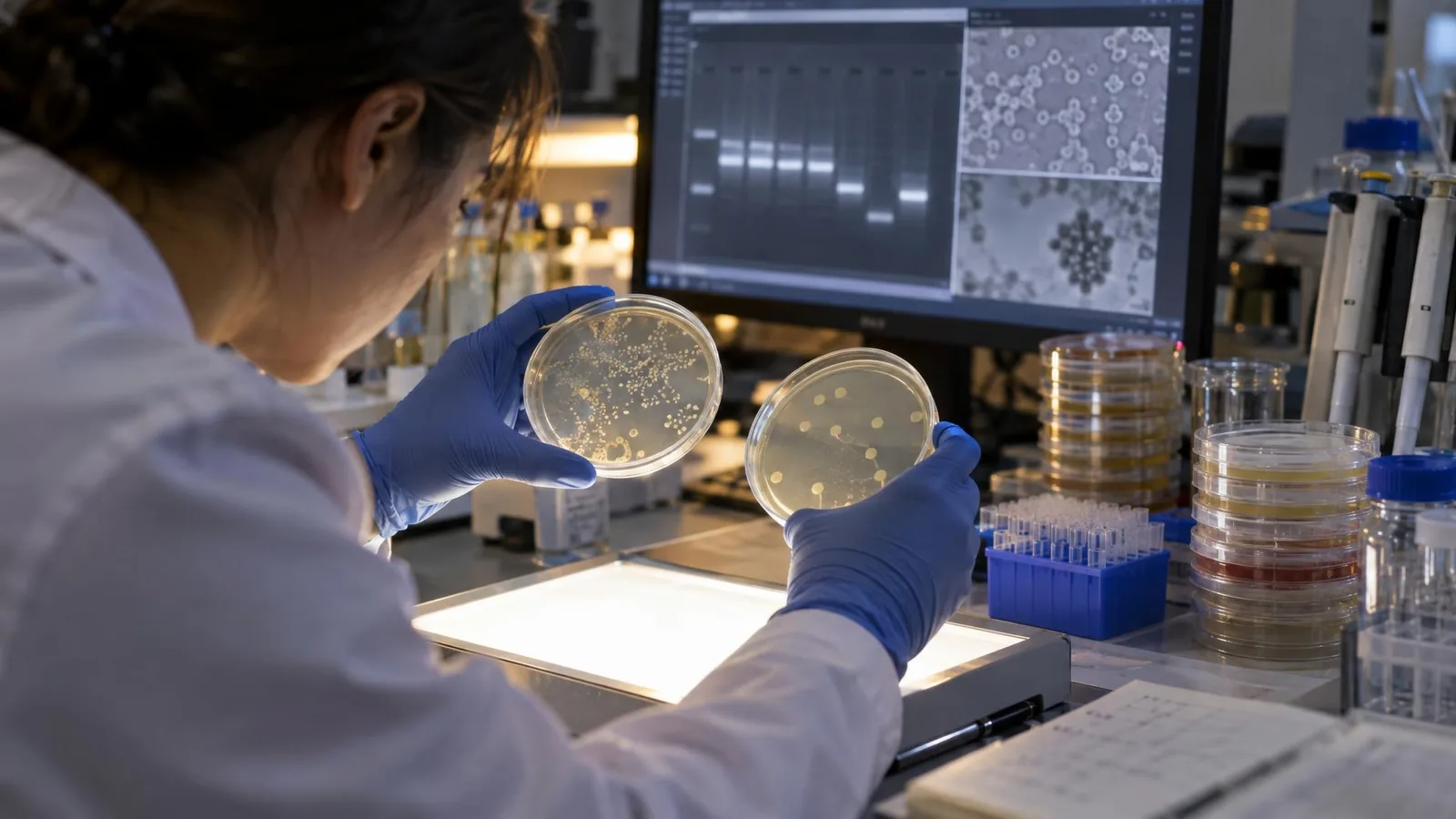
As summarized by Unite.AI, BioBasicsBench targets a gap in evaluations built around charts and images selected for papers: everyday lab work also includes failed runs, ambiguous images, conflicting observations and troubleshooting. Tasks span protein methods, imaging and cytometry, quantification and assays, nucleic acid methods and molecular cloning; inputs can include gel and blot images, colony plates, microscopy stacks, sequencing reads, plate-reader exports, bench photographs and protocol videos. Scientists wrote tasks from their own experiments and grading rubrics; each task received review by a Ligo scientist who had not authored it, an external PhD-level wet-lab scientist, and a final internal review of the prompt, evidence, rubric, author notes and a graded model attempt. The evaluation covered 37 model and reasoning-effort settings with five attempts per task per setting, for 18,500 results.
OpenAI reports mean reward—the average task score as a percentage of available credit. At xhigh, the highest reasoning-effort setting reported for all seven models, GPT-6 Astra reached 66.7% (95% CI 60.3–73.1%) while GPT-5.6 Sol scored 43.8% (37.6–50.0%); Astra averaged about 4,704 output tokens per task versus about 9,099 for Sol. Examples credited to Astra include spotting possible dye crosstalk, rejecting a negative-control plate labeled for the wrong antibiotic, and recognizing a z-stack instead of inventing a biological explanation when cells moved in and out of focus. OpenAI also cautions that higher scores are not yet reliable laboratory judgment—for example a colony-PCR lane-selection error that would purify the wrong plasmid, vacuole contrast that reverses with focal depth, and an roughly 12% colony overcount that would inflate transformation-efficiency estimates by the same proportion. Scores, intervals and examples are secondary reports of the publisher’s claims.